Friday, February 21, 2014

Weather or Not

"Everybody talks about the weather but no one does anything about it."  Charles Dudley Warner (?) stolen by Mark Twain (?).

The big blue whirling planet must have flicked a wrist in one of its daily pirouettes this week and the winds changed direction just enough that the air warmed into the high 60s melting what was left of the squashy snow against the base of the trees and the gray and silver ice that had frozen on the river.  It was almost as if winter had bid goodbye with the setting sun.


The next morning I had rushed to open the windows and let in the fresh air before heading out on errands on a day that only required wearing a sweater.  The sun darted in and out of cloud cover and the wind whipped up old dry leaves and there was a lightness in everyone's step in the supermarket after having been home bound for days.  In the river the buffle heads were back and the Canadian geese had returned the night before.

Of course,  " Breaking up is hard to do. " Neil Sedaka sings.

The winter does not depart without argument and thrashing and screaming and smashing of branches and tossing of furniture like a woman scorned.  Winter hangs on refusing to leave the stage even when pushed away by warmer giggling winds.  Winter hides backstage for a short time tossing rain and  messing with the sound man and flashing light.


There was a tornado warning as I arrived back in my driveway and I rushed to close windows and watch the radar.  Winter was no longer a cool blue on the screen but an angry red and I could hear winter groaning and thundering before roaring into 60 mile an hour winds and driving back against an early departure.  The rain came like hard bullets against the windows and the skylights.  Winter flung 2 inch tree limbs against the side of the house and tipped over the table on the deck in irs fury.


It will be peaceful and warm tomorrow, but I am told winter is coming back in full force next week.  Such a Prima Donna is this season, but to be fair it is not even March!

(Oh, the bird in the prior post with the hair-do was lifting his crown to intimidate.  I understand they sometimes do this for sex appeal.  He was a little blue reddish heron.)

Wednesday, February 19, 2014

Attitude

Success in this life requires being in the right place at the right time and having a little luck.  But we must also give credit for powers of observation.


"Hmmm, wonder what this is all about?"
It does not hurt to have the killer hairdo thing going on.  Throws everyone off their pace and makes them watch you instead of something else.  Give them that intimidating as hell look.


Do not be afraid to jump on it when the opportunity is clear.  Let the others keep their dignity and grace.  You know what rewards dignity and grace give.


And, thus, to the victors go the spoils!!


(Yes, it was bait thrown aside by a fisherman, but food is food even if not as fresh as one is used to.  And as Hilary has corrected me, this is a reddish heron.)

Tuesday, February 18, 2014

Do You Smell That?

Finally the weather has broken for those of us in the more southern east!!  The river has been frozen for over a month...but with today's above 40 temperatures and the beautiful sun I will put on my camouflage uniform, snow boots and cap and head down to the dock.


I hear water dripping and running everywhere.  It is as if the plumbing has broken in earth's bathroom.  The river is still frozen, but thawing as I watch!  I feel as if at least one surreal photo is in order:


Or maybe not...maybe I am ready to face reality.  Wow, that air smells just like the air smells on the top of a snowy mountain.  It is pure and clean and makes me high.  The breeze is cool but gentle as it fingers my gray hair.  I look up and as if someone felt I deserved a little surprise, there not too far over my head glides a bald eagle enjoying the warmer weather.  (He was too acrobatic for a photo, but you can place him and his marvelous air dance in your mind's eye.)

Far out toward the creek where it joins the river I can actually see blue water!  That ice in the foreground is too thin to walk on, so it will be thawed by sunset today.


Can spring be too far behind?

Sunday, February 16, 2014

Back Away Slowly

My goodness, what is this hanging off of my suet feeder?  He is way too big to be balancing up there.  This first photo is not the most flattering, but it did catch my attention.  I see that he is a big bird, larger than the downy woodpecker that usually visits, but closer in size to the red bellied woodpecker. 


But he/she is not a woodpecker.  He stops for a brief moment to shake off the cold rain.  He is a rich rusty brown color.


He has bright yellow eyes with a determined look and above he appears to be long and thin...yet...

here he is thick and ball shaped.  This is what makes birds hard to ID unless you watch them for some time.

This photo above, in better focus, reveals his more normal shape.  It is the brown thrasher, which is most often seen 'thrashing' about in the leaves and looking for bugs under them.  Because of his coloring and the fact that he stays low under bushes he is often hard to see.  He has the most interesting song which can be heard here.  (Scroll down to the middle of the page in that link.)


OKAY, I will put the camera down and back away!

Friday, February 14, 2014

Black and White Friday

Almost all of the color has been drained away.  The color plug was pulled and only charcoal bits and pieces remain for the camera's eye.  But this charcoal is busy and flighty and feisty.  It has a hidden fire that warms the heart looking for any energy these days.  While the nasty fight for survival puts off the small colored friends, I feel that these also have their place in this gray, brown and black world that surrounds me.  At morning time there were over a hundred that filled the trees above.

They are red-winged black birds and common grackles, of course.  The grackles are the top dog in this match.  Their yellow-eyed demonic glare, fuzzy through my window, puts off all but the most predatory.


Both species have trouble with the traditional bird feeder designed for smaller birds.  Eating is a balancing awkward ballet above the ground al la Cirque de Soleil, but all that they spill is welcomed by those on the wet snowy ground below.

And a close up reveals that the new black is really made up of many colors!

Tuesday, February 11, 2014

Bye Bye!

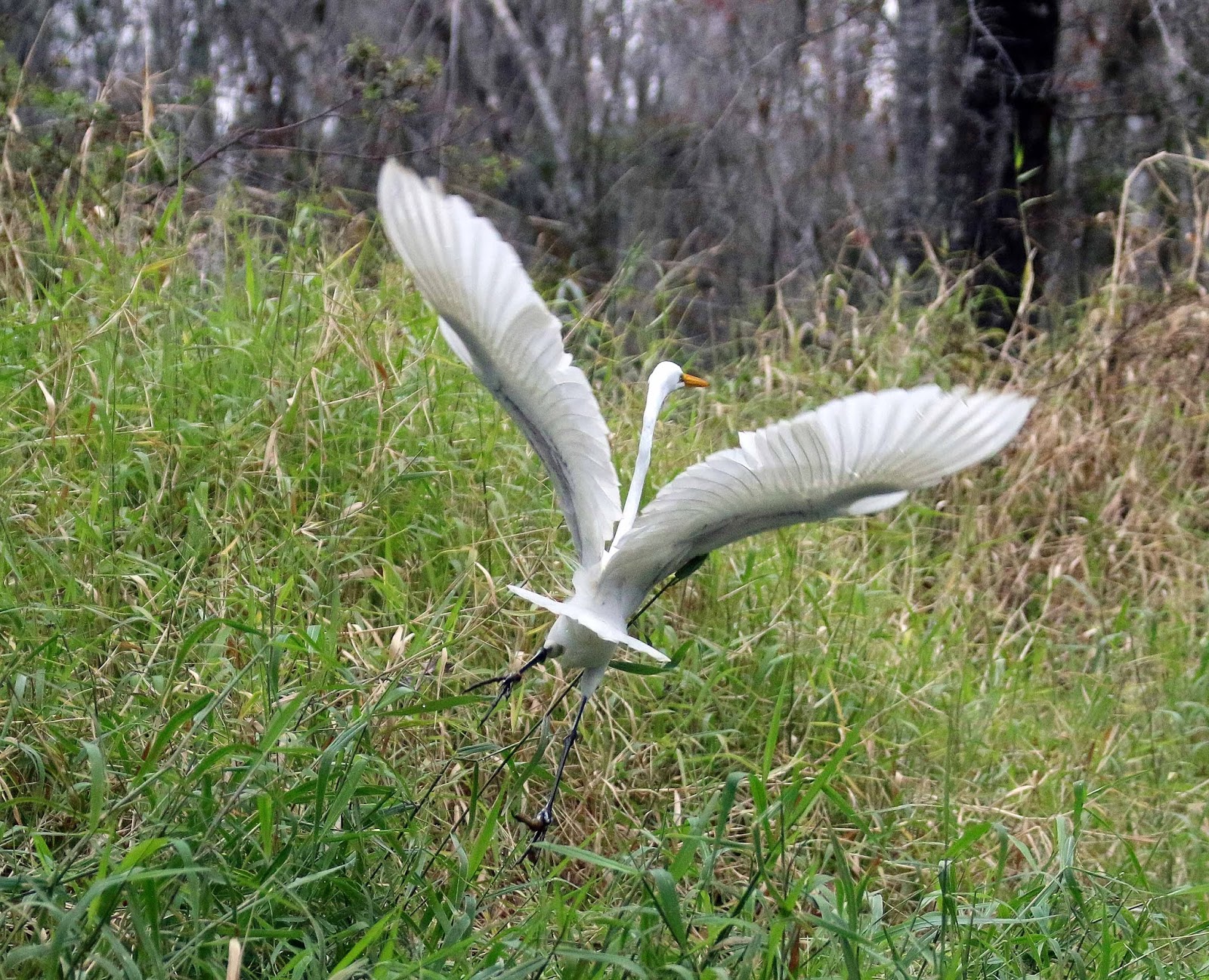
I do not have a professional telephoto nor do I have the ability to make those joining me on my vacation wait until I get that perfect shot. While I saw a lot birds, and got a few good shots, there were many that got away. These below are some of those, grainy and blurry photos, but their graceful departures are worth noting, I think!

Take off is the most energy demanding activity for birds.  Imagine that you are standing at the side of the road and something frightens you and you have to immediately run at your very fastest for some time.  Sometimes take-off can only happen for large birds if they face into the wind.  Bird bones are hollow, body lines are streamlined and wing feathers are not symmetrical so that they have a strong side and a light side all of which aids flight.  One research project found that female birds exposed to predators during ovulation produce chicks which grow their wings faster than chicks produced by predator-free females. Their wings are also longer. Both adaptations may make them better at avoiding avian predators.  Flight is used to avoid prey, reach new feeding grounds, avoid bad weather and get food for young.  Sometimes birds that reach islands where there are no predators and plenty of food lose their ability to fly.  


Sunday, February 09, 2014

The Spring

As I wrote in my post on my other blog,  this spring that we stayed at for a few days is a geological wonder and an historic site, and only available to us because we are friends of the current owners.  Here is the spring itself where I cropped out the intrusive sonar platform.  This spring is so deep that it does not boil the surface of the water.  It always remains crystal clear and glass calm.


We had to work the canoe around a Federal fence that exists to keep out the riffraff and in our case to keep in the riffraff.  We worked our ancient 18-foot aluminum canoe like a surgeons' needle and broke into this pristine opening above on the other side.  We were now in public waters.

Above you can see the tip of the canoe as we now head north about 0.8 mile into the Helena Run which is the outflow from Lake Denham.  Winter in central Florida means no leaves on the trees, just like at home.

This lake Denham seemed so enormous as we sat on its surface because it was so clear, calm and the distant Florida horizon was stretched flat like a gray fuzzy blanket.  In the distance, not seen in this photo, was one lone bass fisherman with his dozen lines placed all around his boat.  As we moved the glassy water, it sometimes felt as if the polished surface would swallow us up never to be heard from again.

Sometimes we got the feeling that we were the only people left to explore on earth.  There was not a breath of air on this cool day and bird sounds were muffled far back into the woods.  In my next post I will show a few of the aviators seen on this float back in time.

Friday, February 07, 2014

Serendipty

Not the endangered whooping crane but the Sandhill crane, more common, is certainly elegant and surprising when you see them.  They are found all across many parts of the mid-west and south.  This bird was seen in fields and near shallow ponds on drive-byes in Florida.  I had hubby stop at a nearby golf course to try and get a closer photo, but it did not look as though I was going to ever get close enough for some real bonding experience.  One rainy afternoon we stopped at a nearby pharmacy so Hubby could pick up some dental floss, and across the edge of the parking lot I saw these Sandhill cranes!

My hands were shaking and I had the telephoto on, so the pictures were blurred because I was too close!  There were four and three were grazing while one was sleeping while cars raced by on the highway.  It was raining lightly and getting me and my camera damp.

These beauties stand almost 4 feet high.  They ignored me, seemingly used to the paparazzi of the elderly in Florida.  Their cry can be heard up to a half mile away.  Mid-westerners are used to their call as they fly overhead during migrating season, sometimes not seen because they are riding a thermal a thousand feet above!

I love their elegant red crown.  A six foot wingspan and a life length of up to 40 years makes them a compelling species.

They let me get closer, even with the stupid telephoto.

Exactly how many times are you going to snap that thing??  

Hey Maggie, this idiot is standing in the rain!

Wednesday, February 05, 2014

The Exotic Ones

My husband was so good to me on this recent trip to Florida.  Of course, he loves canoeing and casting an occasional spinner lure or fly (he brought both rods), but he made it a point to try to get me close to as many birds as possible, exotic tropical water birds.  I think I had the AF setting wrong on many of my shots with my new camera, but since I am not a professional, it did not bother me much.  That is the wonderful thing about being old...you no longer dwell on mistakes because life is way too short and you just try to learn.


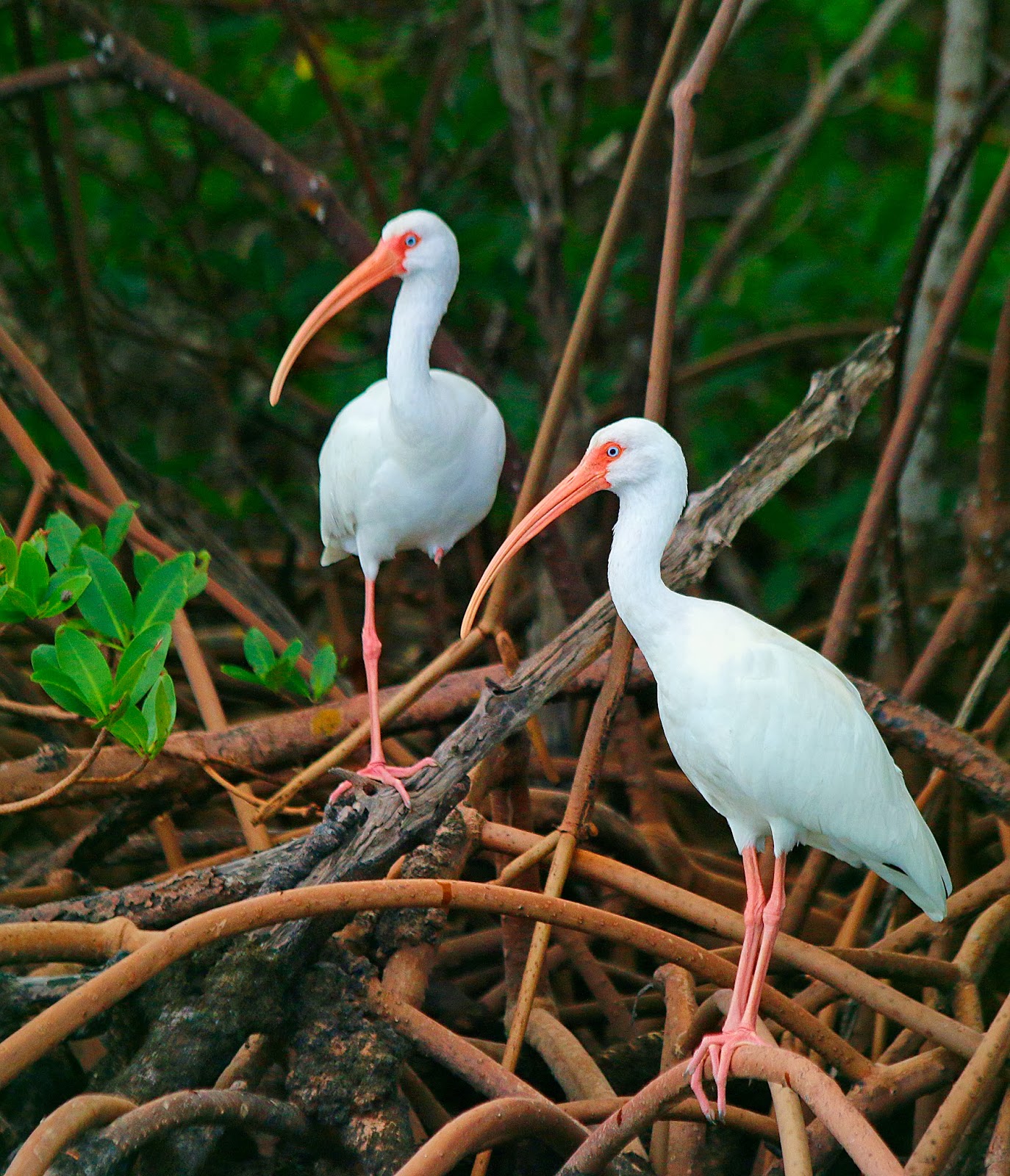
This bird above is one of the most common birds in Florida and this is a boring photo to people who live in the South.  They are seen in front yards, along busy highways and on the sides of the many Florida lakes.  Above they are resting on mangrove roots on an island we paddled by.  Those long orange beaks prod into the lawn and look for bugs, worms and small frogs and underground reptiles.  Studies have shown they spend about 10.25 hours a day looking for food.  The male has it bigger...the bill that is. This is, of course, the white ibis, Scolopax albus. The males and females are identical in coloring and monogamous in their relationships, so perhaps this above is a couple.  They are beautiful in flight with black wingtips and I did not get a photo of that.  Juveniles are brownish-gray. 

According to Wikipedia, native Americans believed the bird was the last to seek shelter before a hurricane, and the first to emerge afterwards, and thus it was symbol for both danger and optimism.  Nice! Below you can just see the small black wing tip in the bird on the right.  The scary robotic looking fellow on the far left is actually a roseate spoonbill.