My goodness, what is this hanging off of my suet feeder? He is way too big to be balancing up there. This first photo is not the most flattering, but it did catch my attention. I see that he is a big bird, larger than the downy woodpecker that usually visits, but closer in size to the red bellied woodpecker.
But he/she is not a woodpecker. He stops for a brief moment to shake off the cold rain. He is a rich rusty brown color.
He has bright yellow eyes with a determined look and above he appears to be long and thin...yet...
here he is thick and ball shaped. This is what makes birds hard to ID unless you watch them for some time.
This photo above, in better focus, reveals his more normal shape. It is the brown thrasher, which is most often seen 'thrashing' about in the leaves and looking for bugs under them. Because of his coloring and the fact that he stays low under bushes he is often hard to see. He has the most interesting song which can be heard here. (Scroll down to the middle of the page in that link.)
OKAY, I will put the camera down and back away!
Sunday, February 16, 2014
Friday, February 14, 2014
Black and White Friday
Almost all of the color has been drained away. The color plug was pulled and only charcoal bits and pieces remain for the camera's eye. But this charcoal is busy and flighty and feisty. It has a hidden fire that warms the heart looking for any energy these days. While the nasty fight for survival puts off the small colored friends, I feel that these also have their place in this gray, brown and black world that surrounds me. At morning time there were over a hundred that filled the trees above.
They are red-winged black birds and common grackles, of course. The grackles are the top dog in this match. Their yellow-eyed demonic glare, fuzzy through my window, puts off all but the most predatory.
Both species have trouble with the traditional bird feeder designed for smaller birds. Eating is a balancing awkward ballet above the ground al la Cirque de Soleil, but all that they spill is welcomed by those on the wet snowy ground below.
And a close up reveals that the new black is really made up of many colors!
They are red-winged black birds and common grackles, of course. The grackles are the top dog in this match. Their yellow-eyed demonic glare, fuzzy through my window, puts off all but the most predatory.
And a close up reveals that the new black is really made up of many colors!
Tuesday, February 11, 2014
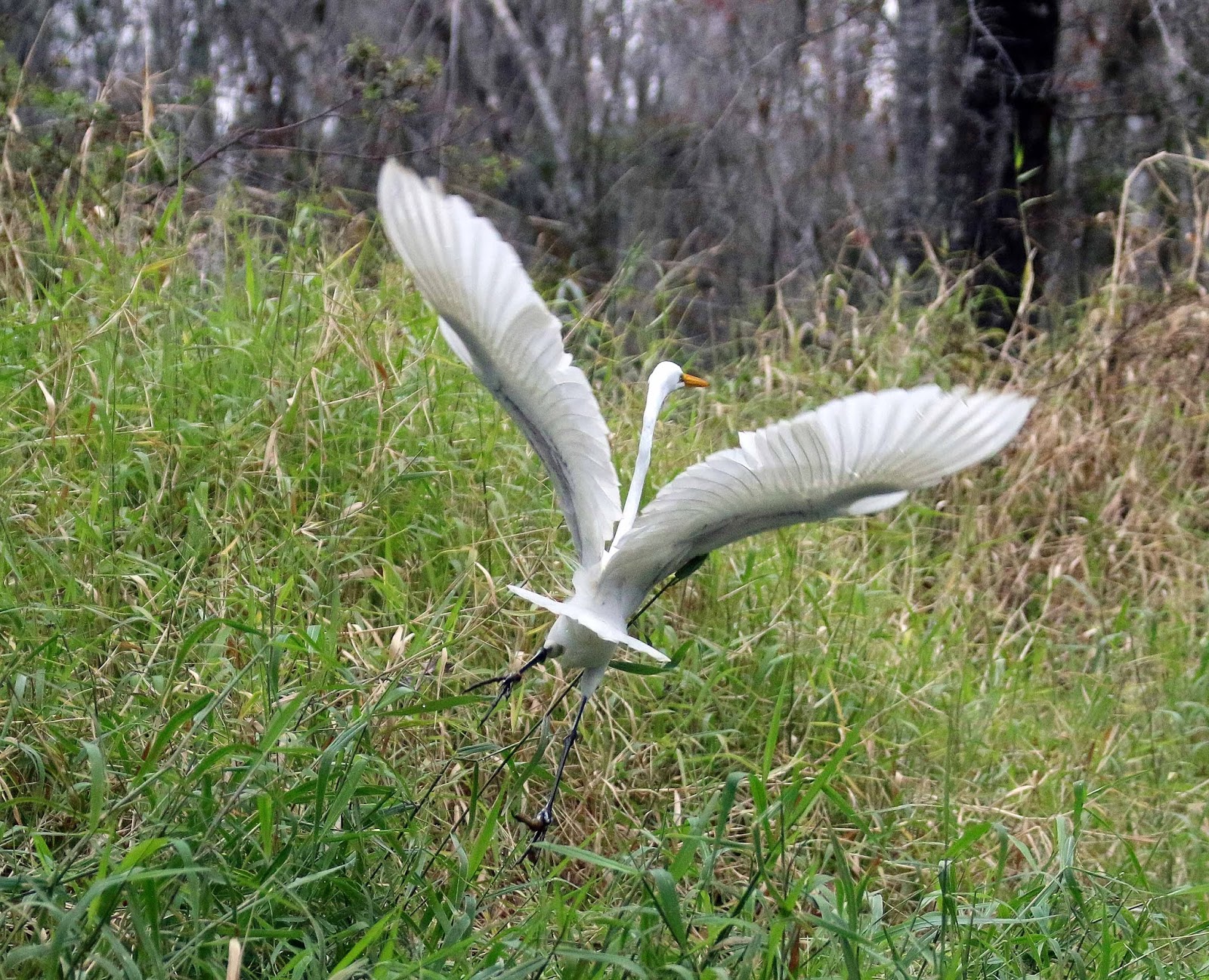
Bye Bye!
I do not have a professional telephoto nor do I have the ability to make those joining me on my vacation wait until I get that perfect shot. While I saw a lot birds, and got a few good shots, there were many that got away. These below are some of those, grainy and blurry photos, but their graceful departures are worth noting, I think!
Take off is the most energy demanding activity for birds. Imagine that you are standing at the side of the road and something frightens you and you have to immediately run at your very fastest for some time. Sometimes take-off can only happen for large birds if they face into the wind. Bird bones are hollow, body lines are streamlined and wing feathers are not symmetrical so that they have a strong side and a light side all of which aids flight. One research project found that female birds exposed to predators during ovulation produce chicks which grow their wings faster than chicks produced by predator-free females. Their wings are also longer. Both adaptations may make them better at avoiding avian predators. Flight is used to avoid prey, reach new feeding grounds, avoid bad weather and get food for young. Sometimes birds that reach islands where there are no predators and plenty of food lose their ability to fly.
Sunday, February 09, 2014
The Spring
As I wrote in my post on my other blog, this spring that we stayed at for a few days is a geological wonder and an historic site, and only available to us because we are friends of the current owners. Here is the spring itself where I cropped out the intrusive sonar platform. This spring is so deep that it does not boil the surface of the water. It always remains crystal clear and glass calm.
We had to work the canoe around a Federal fence that exists to keep out the riffraff and in our case to keep in the riffraff. We worked our ancient 18-foot aluminum canoe like a surgeons' needle and broke into this pristine opening above on the other side. We were now in public waters.
Above you can see the tip of the canoe as we now head north about 0.8 mile into the Helena Run which is the outflow from Lake Denham. Winter in central Florida means no leaves on the trees, just like at home.
This lake Denham seemed so enormous as we sat on its surface because it was so clear, calm and the distant Florida horizon was stretched flat like a gray fuzzy blanket. In the distance, not seen in this photo, was one lone bass fisherman with his dozen lines placed all around his boat. As we moved the glassy water, it sometimes felt as if the polished surface would swallow us up never to be heard from again.
Sometimes we got the feeling that we were the only people left to explore on earth. There was not a breath of air on this cool day and bird sounds were muffled far back into the woods. In my next post I will show a few of the aviators seen on this float back in time.
We had to work the canoe around a Federal fence that exists to keep out the riffraff and in our case to keep in the riffraff. We worked our ancient 18-foot aluminum canoe like a surgeons' needle and broke into this pristine opening above on the other side. We were now in public waters.
Above you can see the tip of the canoe as we now head north about 0.8 mile into the Helena Run which is the outflow from Lake Denham. Winter in central Florida means no leaves on the trees, just like at home.
This lake Denham seemed so enormous as we sat on its surface because it was so clear, calm and the distant Florida horizon was stretched flat like a gray fuzzy blanket. In the distance, not seen in this photo, was one lone bass fisherman with his dozen lines placed all around his boat. As we moved the glassy water, it sometimes felt as if the polished surface would swallow us up never to be heard from again.
Sometimes we got the feeling that we were the only people left to explore on earth. There was not a breath of air on this cool day and bird sounds were muffled far back into the woods. In my next post I will show a few of the aviators seen on this float back in time.
Friday, February 07, 2014
Serendipty
My hands were shaking and I had the telephoto on, so the pictures were blurred because I was too close! There were four and three were grazing while one was sleeping while cars raced by on the highway. It was raining lightly and getting me and my camera damp.
These beauties stand almost 4 feet high. They ignored me, seemingly used to the paparazzi of the elderly in Florida. Their cry can be heard up to a half mile away. Mid-westerners are used to their call as they fly overhead during migrating season, sometimes not seen because they are riding a thermal a thousand feet above!
I love their elegant red crown. A six foot wingspan and a life length of up to 40 years makes them a compelling species.
They let me get closer, even with the stupid telephoto.
![]() | ||||
| Exactly how many times are you going to snap that thing?? |
![]() |
| Hey Maggie, this idiot is standing in the rain! |
Wednesday, February 05, 2014
The Exotic Ones
My husband was so good to me on this recent trip to Florida. Of course, he loves canoeing and casting an occasional spinner lure or fly (he brought both rods), but he made it a point to try to get me close to as many birds as possible, exotic tropical water birds. I think I had the AF setting wrong on many of my shots with my new camera, but since I am not a professional, it did not bother me much. That is the wonderful thing about being old...you no longer dwell on mistakes because life is way too short and you just try to learn.
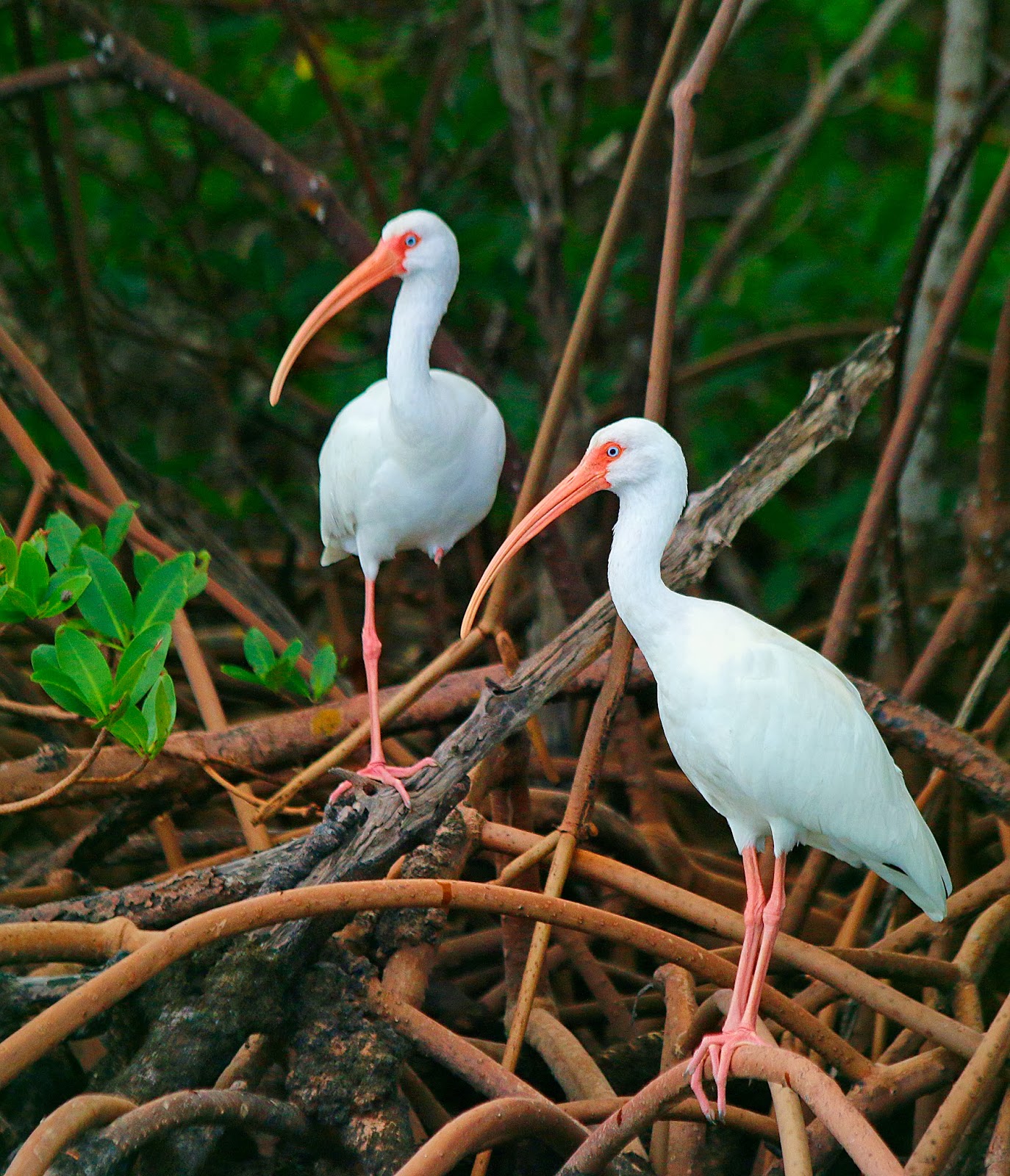
This bird above is one of the most common birds in Florida and this is a boring photo to people who live in the South. They are seen in front yards, along busy highways and on the sides of the many Florida lakes. Above they are resting on mangrove roots on an island we paddled by. Those long orange beaks prod into the lawn and look for bugs, worms and small frogs and underground reptiles. Studies have shown they spend about 10.25 hours a day looking for food. The male has it bigger...the bill that is. This is, of course, the white ibis, Scolopax albus. The males and females are identical in coloring and monogamous in their relationships, so perhaps this above is a couple. They are beautiful in flight with black wingtips and I did not get a photo of that. Juveniles are brownish-gray.
According to Wikipedia, native Americans believed the bird was the last to seek shelter before a hurricane, and the first to emerge afterwards, and thus it was symbol for both danger and optimism. Nice! Below you can just see the small black wing tip in the bird on the right. The scary robotic looking fellow on the far left is actually a roseate spoonbill.
This bird above is one of the most common birds in Florida and this is a boring photo to people who live in the South. They are seen in front yards, along busy highways and on the sides of the many Florida lakes. Above they are resting on mangrove roots on an island we paddled by. Those long orange beaks prod into the lawn and look for bugs, worms and small frogs and underground reptiles. Studies have shown they spend about 10.25 hours a day looking for food. The male has it bigger...the bill that is. This is, of course, the white ibis, Scolopax albus. The males and females are identical in coloring and monogamous in their relationships, so perhaps this above is a couple. They are beautiful in flight with black wingtips and I did not get a photo of that. Juveniles are brownish-gray.
According to Wikipedia, native Americans believed the bird was the last to seek shelter before a hurricane, and the first to emerge afterwards, and thus it was symbol for both danger and optimism. Nice! Below you can just see the small black wing tip in the bird on the right. The scary robotic looking fellow on the far left is actually a roseate spoonbill.
Wednesday, January 15, 2014
She is Hiding
Packing for a trip and when I do that it tends to keep the creative director of my mind in hiding. She is like a cat/dog hiding under the bed when the suitcases are brought out. But she will get over it once I am sitting in the car and gazing out the window and unable to have access to my laptop. Then she will flood my mind with all the ideas she came up with while playing with the dust bunnies.
Here, instead, is last night's sunset as I clean out all the files from my photo chip and pack my cameras. (I now have two as I got a new one for Christmas!)
Monday, January 13, 2014
Thursday, January 09, 2014
Meanwhile, back at the watercooler.
Yes, readers, it is that time of year again, when the elderly confine themselves to the safety and warmth of the house because they have no real life and fill the morning hours by taking photos of the birds at the bird-feeder through their windows leading to a blurry technique and not so funny captions. Bear with me until better weather.
Tuesday, January 07, 2014
The Rampage
Last night the predicted, bitter arctic air left Santa's homeland and savagely battered and whistled outside our door and strained at our windows for hours. We hide ourselves beneath a soft throw and watched the first episode of Season 4 of Downton Abbey which I had taped earlier. It wasn't until after the TV was off and we headed to bed that we heard the howling, moaning, and groaning of the angry winter wind. It was frightening and haunting. It was all those things that make one think of the death of others and even their own death. It was the loneliest sound I had ever heard, much worse than the sad nostalgia of that midnight train whistle that drifts aimlessly across an open field. It was Father Death determined to stay and embrace.
Snow had been predicted after midnight, but when I woke, as I sometimes do, at 4:00, the landscape was dry and brittle under my porch light. I did not open the front door for a more fearless view for concern that I would startle the little wren that lives in the woodpile that we have stacked on the porch. Sending her out into this wind-sheared night would be certain death for her.
The thermostat said it was a balmy 12 F outside! They, those weather people who find these dramatic episodes a gleeful part of their career, had predicted 6 F which would have been even colder when multiplied by the added wind chill! Were they disappointed that they were wrong? Did they 'Aw,shucks' that this had not been accompanied by a blizzard? Were the people up north who have endured this winter's anger for the past two weeks even sympathetic that it now covers two-thirds of the country?
Where were all my feathered friends hidden? Had they found shelter?
I made some coffee and waited for the sunrise and answers.
Snow had been predicted after midnight, but when I woke, as I sometimes do, at 4:00, the landscape was dry and brittle under my porch light. I did not open the front door for a more fearless view for concern that I would startle the little wren that lives in the woodpile that we have stacked on the porch. Sending her out into this wind-sheared night would be certain death for her.
The thermostat said it was a balmy 12 F outside! They, those weather people who find these dramatic episodes a gleeful part of their career, had predicted 6 F which would have been even colder when multiplied by the added wind chill! Were they disappointed that they were wrong? Did they 'Aw,shucks' that this had not been accompanied by a blizzard? Were the people up north who have endured this winter's anger for the past two weeks even sympathetic that it now covers two-thirds of the country?
Where were all my feathered friends hidden? Had they found shelter?
I made some coffee and waited for the sunrise and answers.
Sunday, January 05, 2014
The Big Picture
I do not live in "big sky country" but that does not stop the sky from stretching her blue canvas as far as the tree top horizon and dancing with flirty feathers across the air above my head. This is the sky before our big cold front came through a few days ago. While we did not get the quilts of snow, we did get a taste of winter and about an inch and half of the cold stuff. It was light and fluffy and landed on top of a thin layer of rain that had frozen before the change to snow. Taking a walk the next day was very crunchy and there were no animal tracks as clues of others that might have walked before the sun was up.
![]() |
| This almost looks like waves on the water. |
![]() |
| Here you can begin to see the smear of the wind's (very cold) kiss. |
![]() |
| This one looks like a fire in the sky. |
![]() |
| And this is the end of the winter's day leaving a false mood of peace. |
Wednesday, January 01, 2014
His Majesty
He sits, imperious, holding that regal pose, focused on the tiniest sound of movement and watching that precious lift of a leaf by the wood mouse in search of an errant seed. He glowers, overlooking small birds with various brightly colored feathers that fly across his view and land teasingly close. They ignore His Majesty without fear knowing his diet does not include them, knowing their dive and twist into the woods outmatches his sweep and swerve. Yet the buteo's piercing eyes are magnetic and steely sharp as if they could see below the crust of this winter's earth into the safe den of each small rodent. Broad wings are held tightly against his magnificent body like the drape of a royal cloak soft as a pashmina shawl in the color of warm chestnut. He is both patient and intensely alert in the low angled winter afternoon sun. I am impressed and glad to see him as my yard has been interwoven with the net of tunnels of moles and voles and spring will bring a population explosion.
(Taken through the screened kitchen window one recent afternoon.)
Subscribe to:
Posts (Atom)